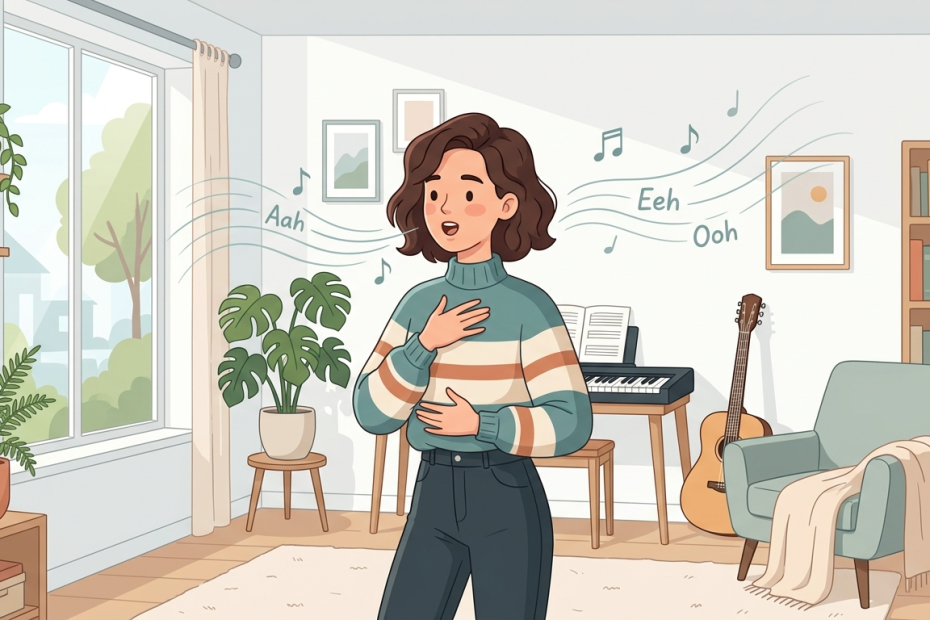

If you want to know how to warm up before singing, the short answer is this: start gently, keep it simple, and help your voice feel ready before you ask it to do bigger work.
A lot of beginners skip this step. They go straight into a song, try to hit the notes, and then wonder why the voice feels stiff, breathy, shaky, or harder to control than expected. That is a very common mistake. A warm-up is not filler. It is one of the easiest ways to make singing feel better, sound steadier, and put less stress on your voice. The National Institute on Deafness and Other Communication Disorders says that voice use at the extremes, singing when the voice is tired or hoarse, and poor voice habits can all increase strain, while good breathing and healthy voice habits help protect the voice.
This article will keep things practical. You’ll learn:
- why warm-ups matter,
- what makes a good warm-up,
- which vocal warm up exercises are actually useful,
- and how to build a short routine you can repeat before singing.
This is one of the easiest ways to start singing better and improving your voice. A good warm-up won’t fix everything on its own, but it makes almost everything else easier.
If you want the bigger roadmap behind all of this, start with the How to Sing guide.
Why warming up matters
Think of a vocal warm-up the same way you would think of warming up before exercise. You do not start sprinting the second you step outside. You loosen the body first. The voice works the same way. It responds better when you ease into the work.
Warm-ups help because they bring your breathing, vocal folds, and resonance into a more coordinated state. Instead of throwing a “cold” voice into a song, you gradually guide it toward clearer, easier sound. That can make singing feel less effortful and more reliable. There is also research suggesting that certain warm-up methods can improve vocal function right away. For example, one study on singers found immediate benefits from semi-occluded vocal tract exercises, a group of warm-ups that includes things like lip trills and straw phonation.
For beginners, the biggest benefit is usually not some dramatic vocal change. It is that the voice starts feeling more cooperative. Notes come out more cleanly. Pitch becomes easier to manage. The throat feels less tight. That matters a lot, especially if you are still figuring out how to improve singing or how to sing better without feeling like you are fighting your own voice.
What a good vocal warm-up should do
A good warm-up should not tire you out. It should not make you push. And it definitely should not hurt.
A good warm-up should do three things:
- wake up the breath,
- wake up the voice gently,
- prepare you for the kind of singing you are about to do.
That means the best voice warm up exercises for singing are usually easy, controlled, and repeatable. They do not need to be loud or dramatic. In fact, if your warm-up already feels like a performance, you are probably doing too much.
For beginners, a useful warm-up usually includes:
- one breath exercise,
- one or two easy sound-based exercises,
- and one short pattern that gets you ready for melody.
That is enough.
Start with breathing, not volume

If your breath is unstable, your singing often feels unstable too. So before making sound, give yourself a moment to reset the breathing.
Stand comfortably. Let your knees stay soft and your shoulders drop. Inhale quietly, then release the air on a soft “sss” sound for about ten seconds. Do that three times. You are not trying to force a long exhale. You are trying to make the airflow smooth and steady.
This matters because the voice is built on moving air. NIDCD explains that the sound of the voice is produced when air from the lungs moves through the vocal folds, and that good breath support is part of healthy voice use.
This simple breath start is one of the easiest ways to support how to improve vocals for singing, because it steadies the foundation underneath the note.
The best warm-ups for beginners
Now let’s get into the actual singing warm ups for beginners.
1. Lip trills
Lip trills are one of the best beginner warm-ups because they encourage easy airflow and discourage pushing. You lightly blow air through relaxed lips so they buzz, like a soft “brrrr.”
Start with a comfortable mid-range note and trill gently for a few seconds. Then slide up slightly and back down. Keep it light. If the trill collapses, that often means the breath is too weak or the body is too tense.
Lip trills are popular for a reason. They help the voice find an easier balance between breath and sound. They are also part of the semi-occluded vocal tract family of exercises that are commonly used in vocal training and therapy.
2. Humming
Humming is simple and very beginner-friendly. It gives you a gentle way to get the voice moving without asking for too much volume.
Try humming on “mmmmm” for a few seconds on one comfortable note. Then move through a short 3-note pattern slowly. Keep the jaw loose and the sound easy.
Humming is useful because it helps many singers find a more forward, resonant sound without overworking the throat.
3. “Ng” to vowel
This is one of the most effective vocal warm up exercises for singers because it teaches the voice to move from easy resonance into a clearer open tone.
Start on the “ng” sound, like the end of the word “sing.” Hold it gently. Then open into “ah” without getting louder. Repeat several times on comfortable notes.
This helps beginners avoid the common mistake of jumping straight into an open vowel with too much force.
4. Gentle sirens
Sirens are smooth slides through a comfortable part of your range. They help connect notes instead of attacking them one by one.
Start low, slide up to the middle or upper-middle part of your range, and come back down. Use “woo” or a lip trill. The point is not range stretching. The point is smooth movement.
5. Easy 3-note patterns
Once the voice is warmed up a little, move into a small pitch pattern like do–re–mi–re–do. This brings you closer to actual singing while still keeping the task small enough to control.
This step is useful if you are also working on how to improve singing voice and how to sing better, because it starts to connect the warm-up to pitch accuracy.
A 10-minute warm-up you can actually use
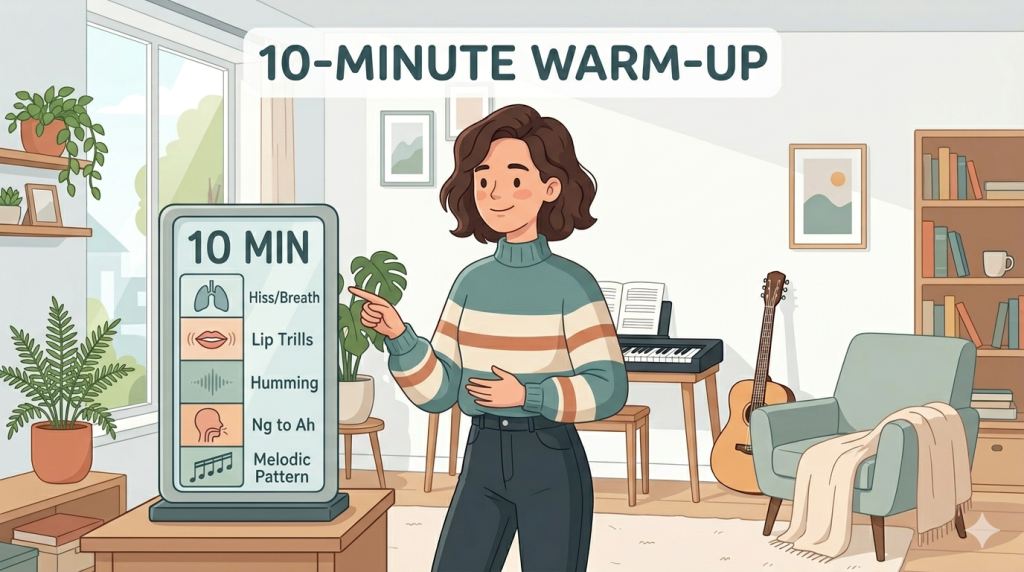
If you’re wondering how to warm up before singing without overthinking it, use this:
Minute 1–2: Breathing
Do the hiss exercise or quiet deep breaths.
Minute 3–4: Lip trills
Use easy slides through the middle of your range.
Minute 5–6: Humming
Hum a few comfortable notes or short patterns.
Minute 7–8: “Ng” to “ah”
Start in easy resonance, then open the sound gently.
Minute 9–10: Short melodic pattern
Do a simple 3-note or 5-note pattern at a comfortable volume.
That is enough for most days.
You do not need a long, complicated warm-up to sing better. You need one that helps the voice feel ready.
How long do you need to warm up before singing?
Most beginners do not need a 30-minute warm-up.
For everyday practice, 5 to 10 minutes is usually enough. If you are singing something more demanding, you might want 10 to 15 minutes. What matters more than length is whether the voice actually feels more settled and easier by the end.
A short warm-up done consistently is better than an elaborate routine you never repeat.
This is important for people trying to figure out how to get better at singing. Consistency wins here. A warm-up only helps if you actually do it.
What not to do before singing
A lot of warm-up problems come from doing too much too soon.
Here are a few useful don’ts:
- Don’t start with your highest or loudest notes.
- Don’t push volume into the warm-up.
- Don’t keep going if the voice feels scratchy or sore.
- Don’t whisper-sing to “play it safe” — very quiet whispering can also stress the voice. NIDCD specifically warns against both screaming and whispering as voice habits that can be stressful for the vocal folds.
- Don’t skip hydration and rest if your voice already feels tired.
In other words, the warm-up should make the voice feel easier, not more worked.
Can warm-ups really help you sing better?
Yes — but not because they are magic.
Warm-ups help because they improve coordination. They make it easier to access clearer breath, steadier tone, and more reliable pitch. They also reduce the chance that you will start the session with too much tension.
A warm-up is not the whole answer to those questions, but it is one of the most useful and realistic daily habits you can build.
If you want the full framework behind these habits, go through the How to Sing guide.
A realistic beginner mindset
It also helps to say this clearly: if warm-ups feel awkward at first, that is normal.
A lot of beginners expect a warm-up to sound polished. It usually doesn’t, especially in the beginning. It should feel useful, not impressive.
Your job is not to sound amazing while warming up. Your job is to get your voice ready.
Once you stop expecting the warm-up to be a performance, it usually becomes much easier to do consistently.
That consistency is where progress comes from.
Conclusion
If you want to know how to warm up before singing, the best answer is: keep it short, easy, and repeatable.
You do not need a complicated routine. You need a few good vocal warm up exercises, done consistently enough that your voice starts to trust them.
For beginners, the best voice warm up exercises for singing are usually the simplest ones:
- calm breathing,
- lip trills,
- humming,
- gentle sirens,
- and short note patterns.
That is enough to make singing feel easier, clearer, and more comfortable.
And if your bigger goal is to improve your singing voice, or even just to feel less tense when you start, warm-ups are one of the easiest places to begin.
For the full roadmap, go through the How to Sing guide.
Frequently Asked Questions
Is it necessary to warm up before singing?
Yes, in most cases it is a very good idea. Warming up helps your voice feel more stable, easier to control, and less strained before you start singing fully.
How long do you need to warm up before singing?
For most beginners, 5 to 10 minutes is enough for a normal practice session. If the singing is more demanding, 10 to 15 minutes may be better.
Can a terrible singer learn to sing?
In many cases, yes. What sounds like a “terrible” voice is often just an untrained voice. With regular practice, better breath control, and clear feedback, most people improve noticeably.
Who can sing all 10 octaves?
Almost nobody. A true 10-octave singing range is extremely unusual and not something most singers should measure themselves against. It has nothing to do with whether you can become a good singer.
Do’s and don’ts before singing?
Do warm up gently, hydrate, and start with comfortable notes. Don’t shout, whisper excessively, force high notes, or sing through pain.
What happens if singers don’t warm up?
Sometimes nothing dramatic happens, but the voice may feel stiffer, less steady, and harder to control. Over time, skipping warm-ups can also make strain more likely, especially if you go straight into demanding singing.