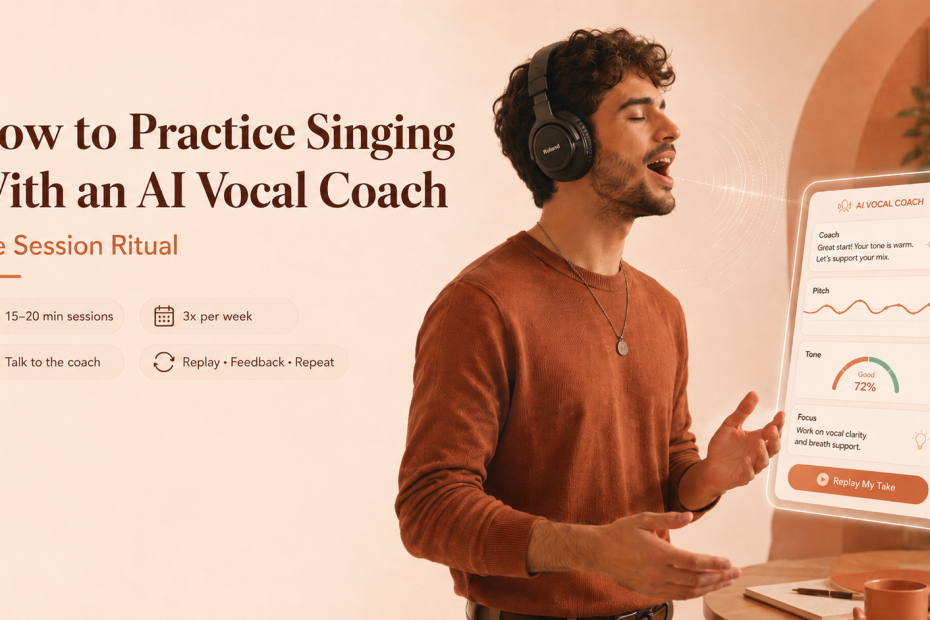
The short version: practice 15–20 minutes per session, three times a week — three short sessions beat one long one every time. Before you sing, tell the coach what you want (or let it lead). While you sing, talk to it: asking questions is the single most underused feature. Afterward, replay one take and leave feedback. Consistency builds the habit; the conversation builds the coaching.
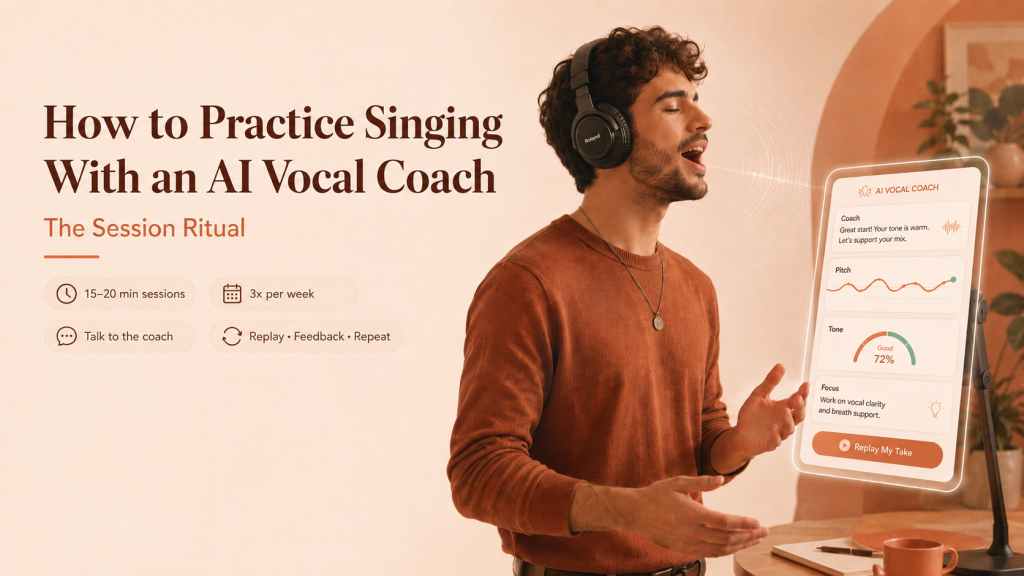
We watch thousands of practice sessions happen on the Singing Carrots AI Vocal Coach, and the difference between singers who improve quickly and those who stall usually isn’t talent, and it isn’t even practice volume. It’s how they use the session. This is the ritual we’d recommend to anyone — most of it applies to any AI vocal coach, and all of it applies to ours.
How long and how often should you practice with the AI vocal Coach?
The numbers we stand behind: a session under about 10 minutes is too short to get much done. 15–20 minutes is the right starting point, and you can go longer as long as your voice feels comfortable — sessions cap at an hour because beyond that there’s usually little additional benefit, and fatigue starts working against you.
Frequency beats duration, decisively. Three 20-minute sessions per week will do more for your voice than one 60-minute session — and infinitely more than the perfect long session you never get around to. Three 30-minute sessions beat three 15-minute ones, sure. But the ordering of priorities is: build the habit first, then lengthen the sessions if your calendar allows.
This matches what the outcome data shows: in seven months of published results, the singers who kept a regular practice rhythm were the ones whose gains held at three months — and singers who completed 6+ sessions expanded their range by 3.6–4.4 semitones, versus 0.9 for those who stopped at five or fewer.
The session ritual, step by step
Six steps — three before and during, three that most people skip.
- Set up so the coach can hear you (2 minutes, once)
The most common frustration in session feedback isn’t the coaching — it’s the microphone. When the mic mishears a note or the visual feedback lags, the whole session feels wrong. So before your first session: quiet room, decent mic (your phone’s built-in one is fine; a headset is better), and run one test exercise to confirm the pitch display tracks your voice. Two minutes of setup buys you every session that follows.
- Decide what to bring — a goal, your teacher’s notes, or nothing
There are three legitimate ways to open a session, and none of them is wrong:
• Bring a goal in plain language. Before each session there’s a field for instructions — use natural words: “I want to work on high notes without straining,” “my chorus keeps going flat.” The coach builds the session around it.
• Bring your teacher’s notes. If you take lessons, this is the feature almost nobody knows exists: ask your teacher to jot down practice instructions, and paste them into that same field. The coach adapts the session to your teacher’s plan — turning it into the practice supervisor for the six days between lessons.
• Bring nothing. Also fine. With no input, the coach starts from your signup answers, checks your pitch stability first, and probes the edges of your range to see where you are today. Arriving open and letting it lead is a designed path, not a failure to prepare.
One piece of quiet advice: whichever way you open, answer the initial questionnaire honestly when you first sign up — your first practice plan is built from it. - While you sing — talk to the AI vocal coach
The single biggest mistake we see is not a technique error: people don’t talk to the coach enough. They treat it like a playlist of exercises — sing, next, sing, next — when there’s a chat built in for exactly the opposite.
Whenever an exercise isn’t clear, ask. The coach can explain why you’re doing this exercise, what skill it targets, and change course if you’d rather work on something else. “Why this one?” “Can we go easier?” “What should I focus on to extend my range?” are all normal things to say mid-session.
And this isn’t just comfort advice… The engagement shows up in outcomes. In the published data, singers with deeper back-and-forth per session came back more often and improved more (+6.2 percentage points versus +4.5 for those who kept it short). Motivated singers both talk more and improve more, so it’s a correlation, not proof. But the conversation is the coaching. A silent session is a pitch meter. - After a take — use the replay
After every attempt there’s a replay button, and it’s the most overlooked feature in the product. It plays back your take with the visual pitch analysis synchronized — you hear your voice and see your pitch line at the same time.
This is the oldest advice in singing pedagogy — record yourself and listen back — with the feedback layer attached. It matters because you physically can’t hear your own voice accurately while singing: bone conduction makes your voice sound deeper and more in-tune inside your head than it is. The replay habit trains your perception to match reality.
You don’t need to replay every take — it interrupts the flow, and nobody has the time. But once or twice a session, pick a take and watch it back. Especially the ones that felt great: the gap between how a take felt and how it sounded is exactly the thing you’re training away. - Rate the session and say why
The rating and the feedback box at the end aren’t a courtesy survey — the coach learns from them. “Too hard today,” “loved the interval work,” “the high exercises hurt” all change what your next session looks like. Thirty seconds here is the cheapest personalization you’ll ever buy.
- Close the loop — schedule the next one
The session isn’t finished until the next one has a slot. Consistency is the entire game — the singers whose gains held at three months were the ones who kept showing up. Pick your three weekly slots and treat them like appointments; the coach will be there at whatever odd hour they land.
The one-sentence summary
Fifteen to twenty minutes, three times a week, with a goal or without one — but never silently: talk to the coach, replay a take, leave feedback, book the next session. That’s the whole ritual. If you haven’t tried a session yet, the first one is free — bring a question to ask it.
FAQ
15–20 minutes is the sweet spot to start; under 10 minutes is too short to accomplish much, and sessions cap at an hour because longer adds little and risks fatigue. Go longer only as long as your voice stays comfortable.
Three sessions a week is the recommendation — and three 20-minute sessions beat one 60-minute session every time. Consistency matters more than session length: build the habit first, then extend the sessions if your schedule allows.
Anything you’d say to a teacher: your goal for the session (“work on high notes without straining”), questions about exercises (“why this one?”, “can we go easier?”), and honest feedback afterward. Talking to the coach is the most underused feature — in published data, singers with deeper conversations improved more than those who practiced silently.
Yes — and there’s a purpose-built way to do it: paste your teacher’s practice instructions into the custom-instructions field before a session, and the coach adapts the session to their plan. It turns the coach into structured supervision for the practice days between lessons.