

If you’ve ever walked out of a voice lesson feeling inspired, only to wonder “How often should I be practicing on my own?” you’re not alone. Adult singers with busy lives often struggle to find the right practice balance. Should you sing every day, or will you risk vocal fatigue? Is a long weekend session enough, or do you need those daily warm-ups? This article dives deep into the science of practice, real stories from singers, and expert tips to answer the big question: How often should you practice between voice lessons?
We’ll explore what research says about building muscle memory and skill, how top vocal coaches and singers approach practice frequency, and ways to make your practice time effective and fun. Whether you sing pop, classical, jazz, or musical theater, the principles are similar. By the end, you’ll have a clear plan for how to practice between lessons – and how to make the most of that time so your voice truly shines.
Why Regular Practice Matters (The Science of Singing Consistently)
Singing is a muscular activity. Just like going to the gym or training for a sport, your voice relies on muscle conditioning and motor learning. One vocal coach put it this way: “Singing is a breath-based muscular activity… the act of repetition and physical practice makes a big difference in how you develop your skills.” This means that every time you practice, you’re training intricate muscles (in your throat, larynx, diaphragm, etc.) and coordinating complex neurological patterns that need consistent reinforcement to improve.
Scientific research backs this up. Studies on motor learning show that skills like singing are acquired and retained through regular, repeated practice. It’s not enough to nail a high note once in your lesson; you have to be able to do it again tomorrow, and the next day, until it becomes second nature. Psychologists differentiate between performance (what you can do right now) and learning (what actually sticks over time). True learning has happened when you can consistently sing that phrase correctly after a break, in various situations – not just immediately after your teacher corrects you.
As one famous saying goes, “If I don’t practice one day, I know it. Two days, the critics know it. Three days, the public knows it.” This highlights how quickly skills can slip without upkeep. For singers, taking several days off in a row can make your next session feel like you’ve lost some ground – your vocal cords and brain need to re-calibrate. A consistent routine prevents that backslide by keeping your voice “in shape” continually.
Moreover, regular practice taps into the “spacing effect” – a well-known principle in psychology. Instead of cramming 3 hours of singing on Sunday, if you spread that time into maybe 20–30 minutes each day, you’ll likely retain techniques better. One Reddit user explained it in simple terms: “A little bit every day is better than chunks every other day.” Repetition with frequency trains you faster and more reliably than one marathon session.
Think of learning to sing like learning to ride a bicycle or play tennis. You wouldn’t expect to improve at tennis by playing only once a week; you’d do drills most days. Singing, especially in Western styles like pop and classical, is similarly a fine coordination task. As one experienced singer pointed out, “You’re building a fine muscle coordination akin to the finesse needed in precision athletics. A tennis player isn’t going to get really good by playing a couple half-hours a week, but by lots and lots of drills.”
Bottom line: Consistency is key. Scientific and anecdotal evidence agree that regular practice (most days of the week) leads to better skill acquisition and retention than sporadic, infrequent practice. Even if those practice sessions are short, the frequency makes a huge difference.
Quality vs. Quantity: The Art of Deliberate Practice
You might be thinking, “Alright, I’ll practice every day then!” – which is great. But beware: simply going through the motions daily isn’t a magic ticket. It’s possible to practice every day and still not improve if your practice lacks focus or proper technique. This is where the concept of deliberate practice comes in.
Deliberate practice, a term popularized by psychologist Anders Ericsson, means practicing with clear goals, focus, and feedback. It’s “the kind of deep, slow, precise practice you need to do to get results” – not always fun or glamorous, but effective. In singing, this could mean focusing on a specific skill (like smoothing out your break, improving breath control on long phrases, or mastering that tricky riff) and working on it methodically.
A voice coach from That Sweet Roar put it this way: “I don’t like to give people a set amount of time per week, because how they’re practicing is much more important… You can get more out of a focused 10-minute practice session than an hour session without the right focus.” In other words, quality trumps quantity. If you spend 15 minutes working carefully on improving your vowel shapes or on one difficult passage – recording yourself, analyzing, adjusting – you’ll gain more than mindlessly singing through songs for an hour while distracted.
What does this mean for your practice frequency? Smaller, more frequent chunks of goal-oriented practice are ideal. For example, four 15-minute sessions spread across a week will likely yield more improvement than one 60-minute session on Saturday, because each mini-session is targeted and you’re coming at it with a fresh mind and voice. This also ties back to avoiding fatigue – shorter sessions reduce the risk of straining and help maintain concentration.
Real-life example: One Reddit singer lamented, “I practice 15-30 minutes a day… for 3 years, but I’m still struggling with scales.” This person had the consistency part down (daily practice), but was frustrated by a lack of progress. A voice teacher responded that the key was how they were practicing and getting feedback. Without guidance, the singer may have been reinforcing bad habits or not addressing the root of the problem. This illustrates that practice isn’t just about clocking hours – it’s about mindful improvement. If you have a teacher, use their feedback each week to guide your solo practice. If not, consider tools that can give you feedback on your pitch, timing, etc., so you’re not practicing in a vacuum.
Advice from Vocal Coaches and Experienced Singers
What do professional singers and voice teachers say about practice frequency? The consensus is clear: almost every day, if you can, but with some structure and balance. Here are some guidelines and insights gathered from experts and online communities:
- Aim for 5–6 days a week of practice: Many vocal coaches recommend practicing on most days. One singing instructor on Reddit advised: “Ideally: once a day, 5–7 days a week.” Vocalists who have undergone serious training often practice almost daily. For example, a classically trained singer shared that during college, they practiced 5–6 days a week for about an hour a day to build technique and stamina.
- Keep practice sessions manageable in length: More practice days don’t mean burning out your voice with hours each day. It’s recommended to split practice into shorter sessions. One instructor noted, “Never in one sitting… 2 or 3 15-20 minute sessions throughout the day will do better than one hour straight.” This echoes expert advice: frequency is more important than duration.
- Build up stamina gradually: If you’re not used to practicing daily, start small. One student began with “15 minutes a day, every day,” and gradually increased the length and frequency as their stamina improved. Pushing too hard too soon can lead to vocal fatigue – similar to starting a marathon without training.
- Yes, you need rest days: Even though frequent practice is ideal, rest is a non-negotiable part of good singing practice. Most coaches advise at least one day off each week to let your vocal folds recover. Listen to your body: if your voice feels raw or tired, take a day off.
- Mix technique drills with song practice: Not all practice has to be full-throttle singing. On days with intense rehearsals, supplement with technical exercises or even silent practice (like memorizing lyrics). This strategy helps keep your overall routine balanced.
- Maintain a routine even when busy: Many adult singers juggle work, family, and commitments. Creative strategies, like tying practice to another daily habit (for example, warming up right after brushing your teeth), can help maintain consistency. Even 5–10 minutes is better than nothing.
In summary, expert advice and community experiences suggest that consistent, mindful practice every day (or nearly every day) is key to steady improvement.
Making Practice Fun and Effective with Technology (Singing Carrots)
One of the hardest parts of practicing between lessons is doing it alone. Without your teacher or pianist present, how do you know if you’re on the right track? How do you stay motivated to work through scales and exercises? This is where technology can be a game-changer. Apps and online platforms can act like a “coach” in your pocket, providing structure, feedback, and motivation.
Singing Carrots is one such platform – and it’s tailored specifically to help singers practice effectively between lessons. Many voice teachers recommend Singing Carrots for at-home practice. As the platform notes, it provides expert-backed, data-driven tools that support your progress.
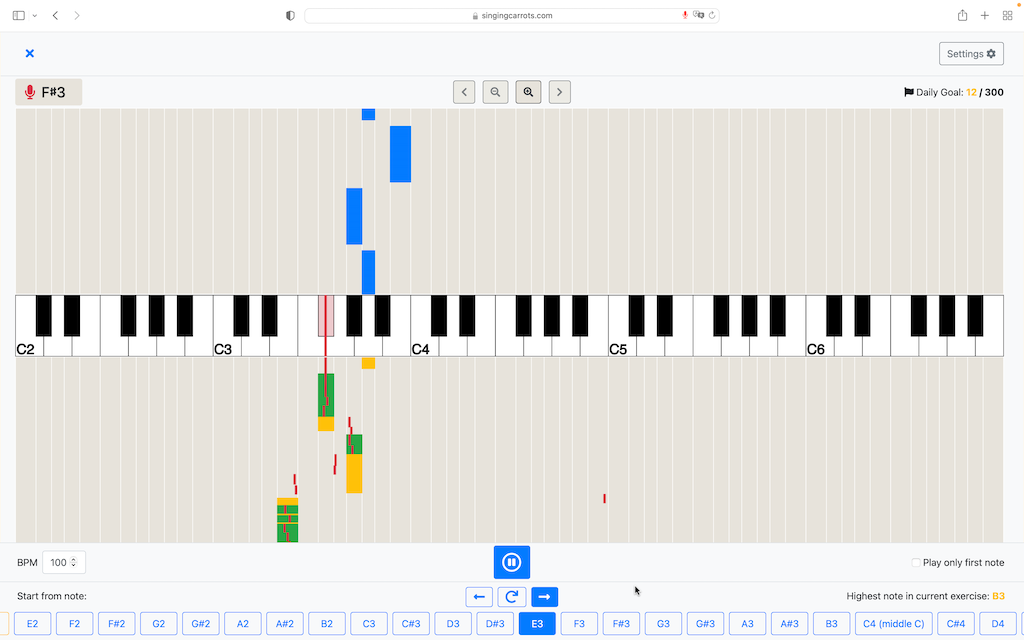
Personalized feedback: When practicing alone, it can be hard to gauge whether you’re truly in tune or maintaining steady support. Singing Carrots provides immediate visual and audio feedback. In the Pitch Training game, for example, you sing into your microphone and see a display of your pitch versus the correct pitch. This instant feedback helps you adjust on the fly and ensures you’re practicing correctly.
Analytics and tracking: Singing Carrots also tracks your progress with detailed analytics. Every time you practice, it records data on your pitch accuracy, vocal range, and more. The Statistics Dashboard displays your progress in clear graphs, showing improvements over time – a real motivator for many users.
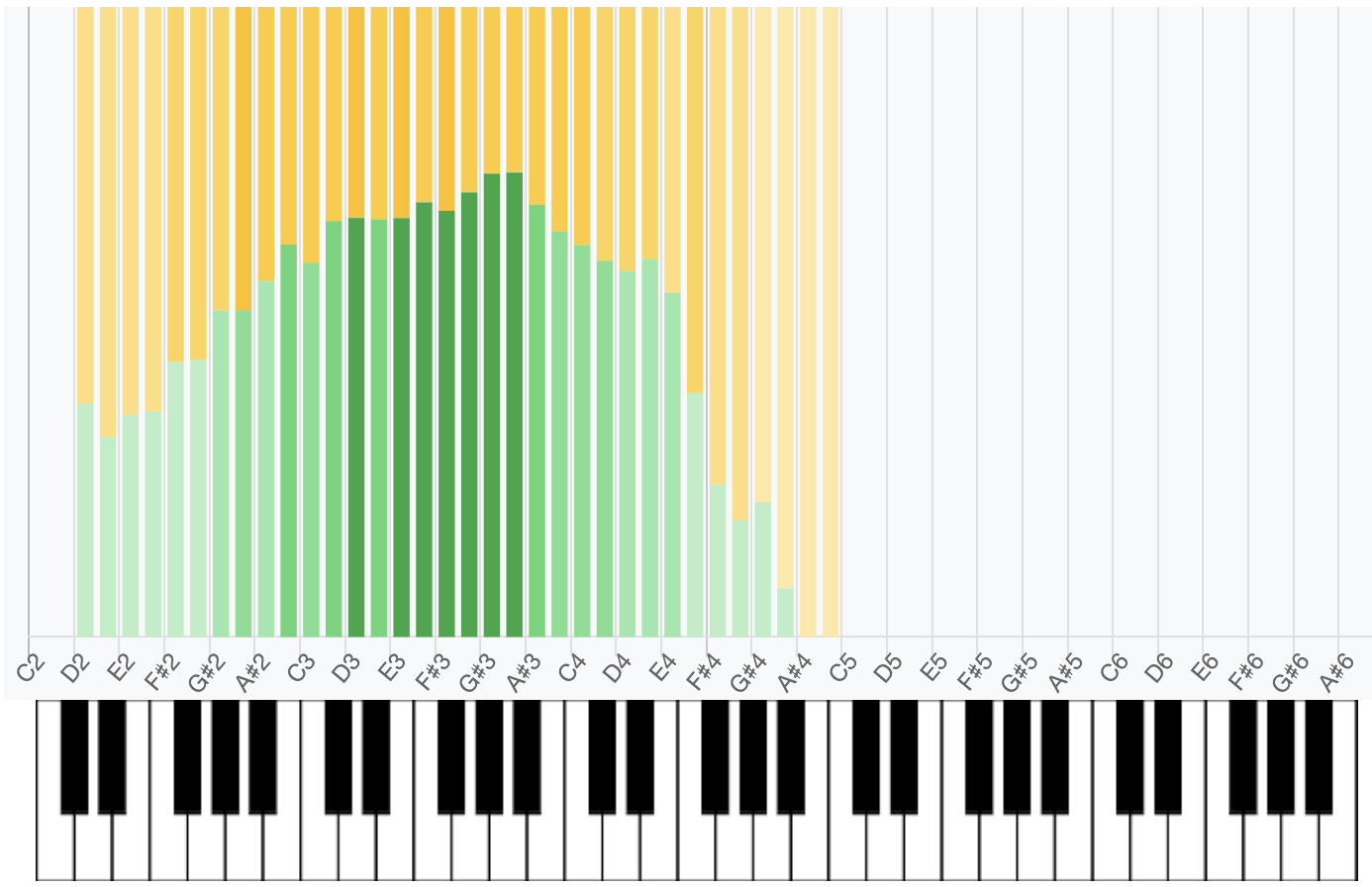
Structured exercises and courses: Not sure what to practice? Singing Carrots offers a toolbox of structured exercises – from vocal range tests to breathing exercises – as well as guided courses that complement what you learn in your voice lessons.
Motivation through success stories: Many users report significant improvements in just a few weeks. Seeing concrete data – like a jump in pitch accuracy or an expanded vocal range – can be incredibly motivating. The platform’s data-driven approach reinforces the message: “Consistent practice is the key to vocal improvement.”
As Singing Carrots itself emphasizes, “Can you just go to a singing lesson once every one or two weeks without practicing regularly and still improve? Definitely not.” With its expert-designed tools and community support, Singing Carrots ensures that between your voice lessons, you’re never left wondering if you’re on track.
Finding Your Perfect Practice Routine (Putting It All Together)
Now that we’ve looked at research, expert advice, personal stories, and even tech solutions, let’s answer the question plainly: How often should you practice between voice lessons?
For most adult singers taking weekly (or bi-weekly) lessons, a good rule of thumb is:
- Practice on most days of the week: Aim for at least 4–5 days a week, preferably more. Even short daily practice sessions will keep your voice conditioned and the lesson material fresh.
- Keep practice sessions focused: Start with 15-30 minutes a day if you’re a beginner or have a busy schedule. Intermediate singers might stretch that to 30-60 minutes, while advanced singers often break their sessions into multiple focused blocks.
- Use your lesson as a springboard: Let your teacher’s feedback guide your practice. For example, if you learned a new breathing technique, plan to incorporate that exercise into your daily routine until it becomes second nature.
- Include rest days: Your vocal folds are delicate and need recovery time. Generally, plan for at least one full rest day per week. Listen to your body – if your voice feels strained, give it the break it needs.
- Adapt to your genre and goals: Western singing styles may demand different approaches, but all benefit from consistent, structured practice. Tailor your routine to your personal goals – whether it’s nailing pop riffs, mastering classical scales, or perfecting your musical theater performance.
- Stay flexible: Life can be unpredictable. If you miss a day or two, resume your practice as soon as possible. Even minimal daily exercises can keep your voice sharp until you can commit to longer sessions.
Your voice thrives on consistency. Voice lessons are essential for guidance, but the real magic happens when you practice on your own. By practicing consistently and mindfully – whether it’s 15 minutes or an hour each day – you’re investing in your future as a singer.
So, how often should you practice between voice lessons? As often as you can, consistently, and with attention to technique and rest. Each small session builds toward a stronger, more confident you.
Now get out there and sing – today, tomorrow, and every day in between. Your future self (and your voice teacher) will thank you for it.
Sources:
- Julia Nilon, “Singing – How Often Should I Practise?” (2021) – The importance of consistency and muscle memory
- Reddit – r/singing community insights – Experienced singers’ advice on daily practice vs. occasional practice
- That Sweet Roar – “How Often Should You Practice Singing?” – On deep practice and focused sessions
- Singing Carrots – Platform features and user testimonials