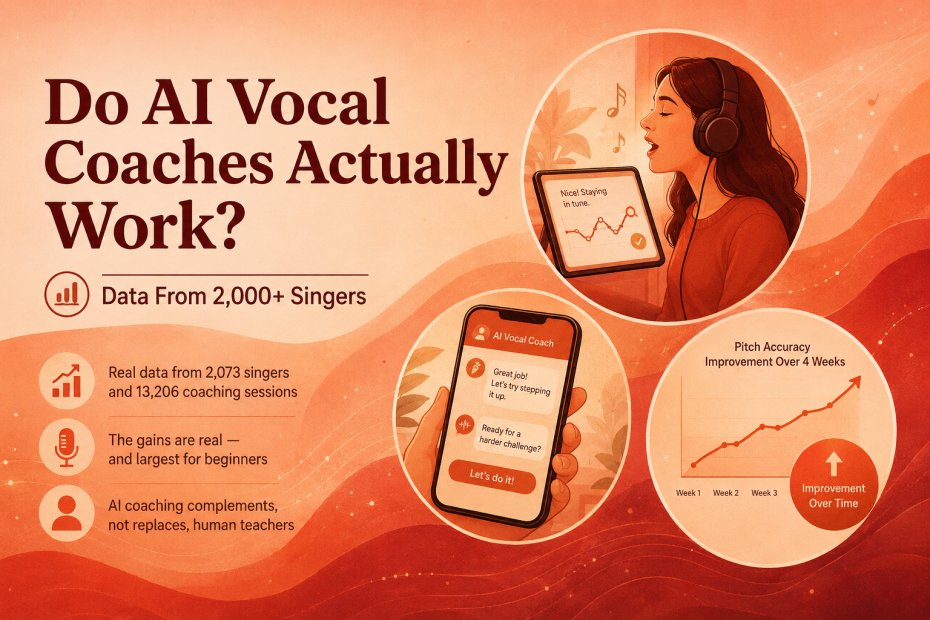
Yes, AI Vocal Coaches can work, within limits our data make clear. Across 2,073 singers and 13,206 sessions on the Singing Carrots AI Vocal Coach, pitch accuracy improved +5.9 percentage points in four weeks, with beginners gaining +16.5. Independent research on real-time visual pitch feedback points the same way. The gains are real and largest for beginners. Still, no app replaces a human teacher for advanced technique.
Transparency note: Singing Carrots publishes this article and builds an AI vocal coach. Every claim about our own results links to the published data, the limitations are stated in full, and the independent research cited below predates our product by decades.
What does “working” actually mean for a singing app?
Before the evidence, the definition. Why? Because “does it work” hides three different questions. Does it improve a measurable skill, like singing on pitch? Does the improvement last, or fade when the novelty does? And does it work for you specifically, given where you’re starting from?
This article answers all three for the measurable core of singing: pitch accuracy and vocal range. It does not claim AI coaching develops artistry, stage presence, or emotional interpretation. No app measures those, and anyone claiming otherwise is selling something.
What do the data show?
The largest published dataset on AI vocal coaching outcomes is Singing Carrots’ own: seven months of results from 2,073 singers and 13,206 coaching sessions, published with methodology and confidence intervals. Four findings matter for the skeptic’s question:
• The core result replicated. Pitch accuracy improved +5.9 percentage points over four weeks in a paired analysis of 358 singers — nearly identical to the +6.1 found at the four-month mark with a smaller sample. A number that holds steady while the sample doubles is the opposite of a fluke.
• Beginners gained the most, by far. Singers who started below 75% accuracy gained +16.5 percentage points; singers who were already accurate barely moved. The same gradient appears independently in vocal range. If you’ve been told you can’t sing, you’re the person the data is most optimistic about.
• The gains held. Among the 94 singers trackable for three months or more, the improvement was still there: +6.1 points versus their first week. Not a honeymoon spike.
• Engagement tracked outcomes. Singers who had deeper back-and-forth with the coach practiced more and improved more (+6.2pp vs +4.5pp) — a correlation, since motivated singers both talk more and improve more, but a consistent one.
Deliberately absent from this page: the full tables, per-band breakdowns, and confidence intervals. They live in the 7-months analysis, which is the citable artifact behind every number above.
Is the coaching real, or just a pitch meter with a chat window?
A fair question — “AI” is the most abused word in the App Store. The mechanism has its own published analysis: across roughly 349,000 exercises, the coach places 91.5% of them inside each singer’s demonstrated comfortable range, and makes the next exercise harder 31.5% of the time after a success versus 3% after a struggle — a 10x swing that a fixed script cannot produce. The full breakdown, including what the coach does in your first session before it has heard you sing, is in What actually happens when you sing to an AI coach.
What does independent research say?
The principle underneath AI vocal coaching — real-time visual pitch feedback — was validated by academic research decades before any app existed.
In 1989, Graham Welch, David Howard, and Cynthia Rush published a landmark study showing that students receiving real-time visual pitch feedback improved pitch accuracy significantly more than control groups — and that the improvement transferred to singing without the visual aid after sufficient practice [1]. Later classroom research found the same: concurrent-feedback software measurably improved children’s pitch-matching versus conventional instruction [2].
The research also explains who benefits. Hutchins and Peretz showed that most poor singing is a motor-coordination problem, not a hearing problem — untrained singers can hear pitch differences fine; they haven’t yet built the ear-to-larynx connection that produces them [3]. That is precisely the connection feedback-based practice trains. True congenital amusia — clinical “tone deafness” where pitch perception itself is impaired — affects only a small minority of the population [4].
Put together: the mechanism AI vocal coaches automate is one of the best-evidenced interventions in singing pedagogy. What’s new is not the principle; it’s the price and the availability.
What can’t the data prove?
Stated plainly, because the honest version of “yes” includes these:
• No control group. Coached singers improved; whether identical singers doing the same volume of self-guided practice would have improved equally is unmeasured. Some of the gain is coaching, some is simply practicing more — though practicing more is partly what the coaching causes.
• Self-selection. People who stick with practice are more motivated to begin with. The durability and engagement findings describe those who stayed.
• Regression to the mean. Part of the large beginner gain is statistical. The true beginner gain is likely somewhat smaller than +16.5 points — the gradient across two independent metrics is why we believe the effect is real.
The complete limitations section — small subsets, noisy range measurements, why three months is still early — is in the source analysis. The direction is consistent across every cut of the data; “consistent with” is the right phrase, “proves” is not.
Who should — and shouldn’t — expect results?
Expect results if: you’re a beginner or intermediate singer working on pitch, range, or consistency, and you’ll practice a few times a week. The data’s strongest case is for exactly this group — and adults learn faster than they think.
Expect a plateau if: you’re already singing above ~92% pitch accuracy. In the data, already-strong singers barely moved on this metric — their next gains live in areas apps don’t yet measure: interpretation, stylistic control, stamina.
Expect limits if: you’re in the small minority with clinical amusia (impaired pitch perception itself) — improvement will be limited, though most people who believe they’re tone deaf are actually untrained, which is trainable. And for advanced technique, vocal health concerns, or performance coaching, a human teacher is the right call: an AI coach handles daily deliberate practice; it doesn’t watch your posture or hear what an experienced ear hears. Most singers who progress fastest combine both. Here’s the full picture.
The verdict
For the measurable core of singing — accuracy and range — AI vocal coaching works, with the strongest and most durable effect for beginners, and the evidence runs in two independent lanes: seven months of published product data, and decades of academic research on the feedback principle underneath it. What it doesn’t do is replace human teaching at the top of the skill curve, and the honest data says so out loud. If you want to test the claim on the only voice that matters — yours — try the AI vocal coach and judge the adaptation yourself.
Read more: Is the Singing Carrots AI Vocal Coach worth it?
FAQ
Yes — the core principle predates the apps. A 1989 study by Welch, Howard, and Rush showed real-time visual pitch feedback significantly improved pitch accuracy versus control groups, with gains that transferred once the feedback was removed. Later classroom studies replicated the effect. AI coaching automates and personalizes that same principle.
For pitch accuracy and range: yes, the data supports it — beginners gained +16.5 percentage points in four weeks across 70 singers, and gains held at three months. For artistry, advanced technique, and vocal health, an app is a complement to human teaching, not a substitute. The realistic comparison for most people is app versus nothing, not app versus teacher.
Usually, yes — because most people who think they’re tone deaf aren’t. Research distinguishes true congenital amusia (impaired pitch perception, a small minority of the population) from untrained singing, which is a motor-coordination gap: you hear the note fine, you just can’t produce it consistently yet. The second is exactly what feedback-based practice trains. In the data, the least accurate singers improved the most.
If you’re a beginner practicing regularly: a measurable pitch-accuracy jump within the first month (the average across all levels was +5.9 percentage points at four weeks; beginners far more), gradual range expansion, and gains that persist if you keep practicing. If you’re already accurate, expect refinement and consistency rather than headline jumps.
References
[1] Welch, G. F., Howard, D. M., & Rush, C. (1989). Real-time visual feedback in the development of vocal pitch accuracy in singing. Psychology of Music, 17(2), 146–157.
[2] Paney, A. S., & Kay, A. C. (2015). Developing singing in third-grade music classrooms: The effect of a concurrent-feedback computer game on pitch-matching skills. Update: Applications of Research in Music Education, 34(1), 42–49.
[3] Hutchins, S., & Peretz, I. (2012). A frog in your throat or in your ear? Searching for the causes of poor singing. Journal of Experimental Psychology: General, 141(1), 76–97.
[4] Peretz, I., & Vuvan, D. T. (2017). Prevalence of congenital amusia. European Journal of Human Genetics, 25(5), 625–630.
Primary data: AI Singing Coach, 7 Months In (Singing Carrots) · What Actually Happens When You Sing to an AI Coach (Singing Carrots)