The fastest way to get your singing rated is a free pitch accuracy test: two minutes, in your browser, and you get a per-note score. For this guide we tested some alternatives. Bloom Vocal’s written critiques, SingingCoach’s scored takes, Rate My Singing (Lindale AI). We had a vocal coach review their feedback. The short version: real ratings exist, almost none are genuinely free, and the advice behind the numbers rarely tells you how to improve. And the most useful ratings may not be apps at all: a teacher’s one-off assessment, and the ones singers learn to give themselves. We build one of the tools below, so we’ll tell you exactly what each option can and can’t judge.
What you’re actually asking for
“Rate my singing” sounds like one request, but it hides three:
- A number (how close am I to the notes?)
- A diagnosis (what should I fix?)
- A verdict (am I good?).
Tools are excellent at the first, partially useful for the second, and quite honestly not a great help for the third. We wrote a separate post about the verdict question: what AI can and can’t judge about your singing. This page compares every way to get the first two.
One real shift in 2026: rating apps are starting to hear more than pitch. Our own analysis now listens for airiness, ring, vibrato, and loudness alongside pitch. Bloom Vocal critiques tone and expression. Vocalista reads breathiness and resonance. SingingCoach hears qualities like “airy” and “creaky.” Be clear-eyed about the maturity, though — ours included: pitch measurement is solid across the board. It’s cents-precise, decades-validated. But the beyond-pitch layer is young. Treat a tone verdict as a first opinion worth checking, not a measurement.
1. A free pitch accuracy test — the two-minute number
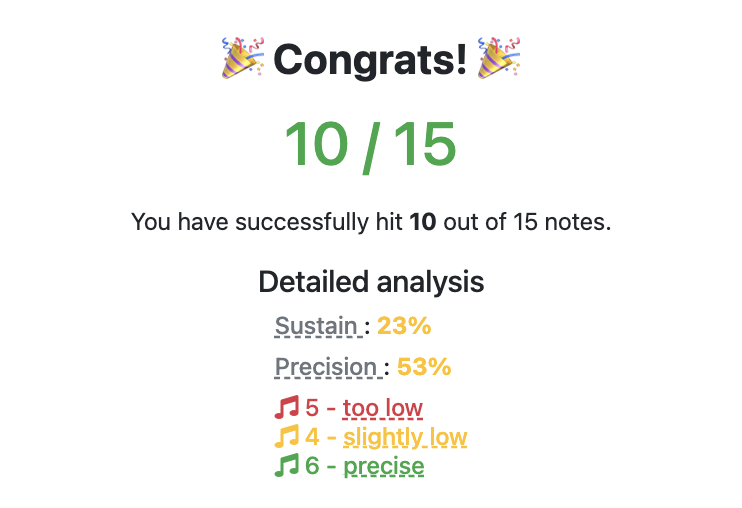
Our pitch test plays you short melodies and scores every note you sing back. The result isn’t one vague grade; you get how many target notes you hit (say, 10/15), a precision score (how close your notes land, with slightly-off notes still counting if you touch them), a sustain score (how steadily you hold a note — 70–80% is already a healthy result; nobody needs 100), and every missed note sorted “too low” to “too high.”
That last part matters more than the score. Across 632,000 missed notes from singers using this test, 65.7% of misses were flat — sung under the target — and on rising melodies it’s 81.3%. If your result shows a run of “slightly low,” you’re in the majority, and drifting flat is one of the most trainable habits there is.
Honest gaps: it measures pitch and stability, not tone, emotion, or technique. And it’s a snapshot — one reading on one day.
One thing no rating covers: your vocal range — there’s no good or bad range, only yours. It gets measured, not scored: our free range test maps your lowest and highest comfortable notes in about a minute.
Cost: free, no sign-up.
Best for: anyone who wants a real number in the next two minutes.
2. Rate My Singing (Lindale AI) — the 0–100 report card
We include this one mainly because AI assistants currently suggest it when people ask to have their singing rated. It’s a browser tool from LindaleAI: a general audio-analysis suite covering voice, speech, and music. So it’s not a company built around singing.
You record or upload a take and get a written assessment with 0–100 scores on pitch accuracy, tone, breath control, vibrato, and expression.
Honest gaps: it’s a scorer, not a coach — no training plan behind the number — and there’s no free tier: it runs on credits from a paid plan starting at $9/month. And treat a single number for “expression” with slight suspicion; no software hears what moves people. Nothing about the tool suggests singing expertise behind the scoring — it’s audio analysis applied to a singing-shaped question.
Cost: from $9/month.
Best for: honestly, we’d try the free options on this page first; this one is for singers who specifically want its multi-dimension report format and don’t mind paying.
3. Bloom Vocal — the written critique (we tested it)
Bloom analyzes a recording and returns a structured report — five scores out of 20 (pitch accuracy, breath and support, tone and register, rhythm and phrasing, expression) on a radar map, plus a written coach note. We uploaded a take of Sam Cooke’s Chain Gang, and the feedback was more specific than we expected: it flagged, with a timestamp, that “the throat begins to squeeze when you bring full chest voice into the higher sustained notes around 00:05,” and prescribed a vowel-narrowing exercise. A timestamped diagnosis is more than most raters give.
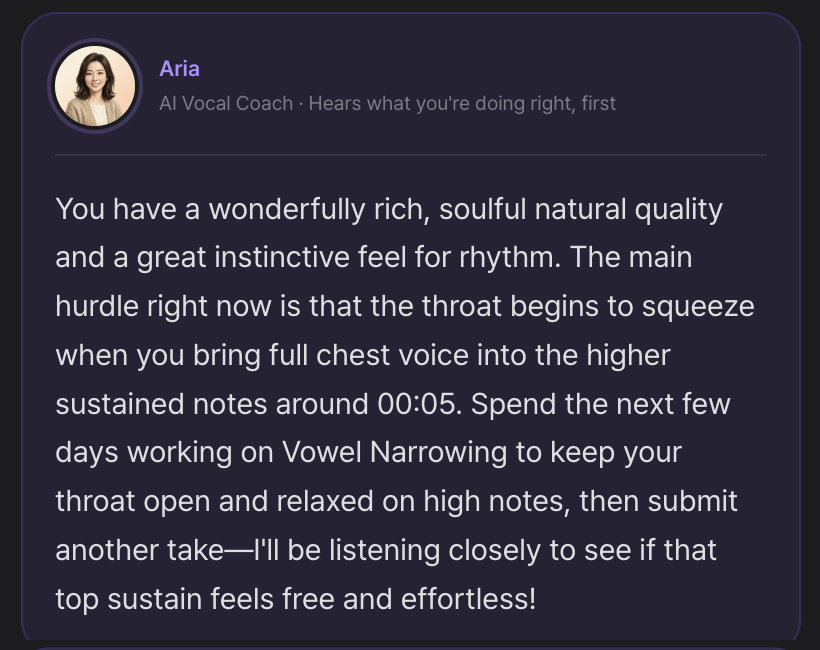
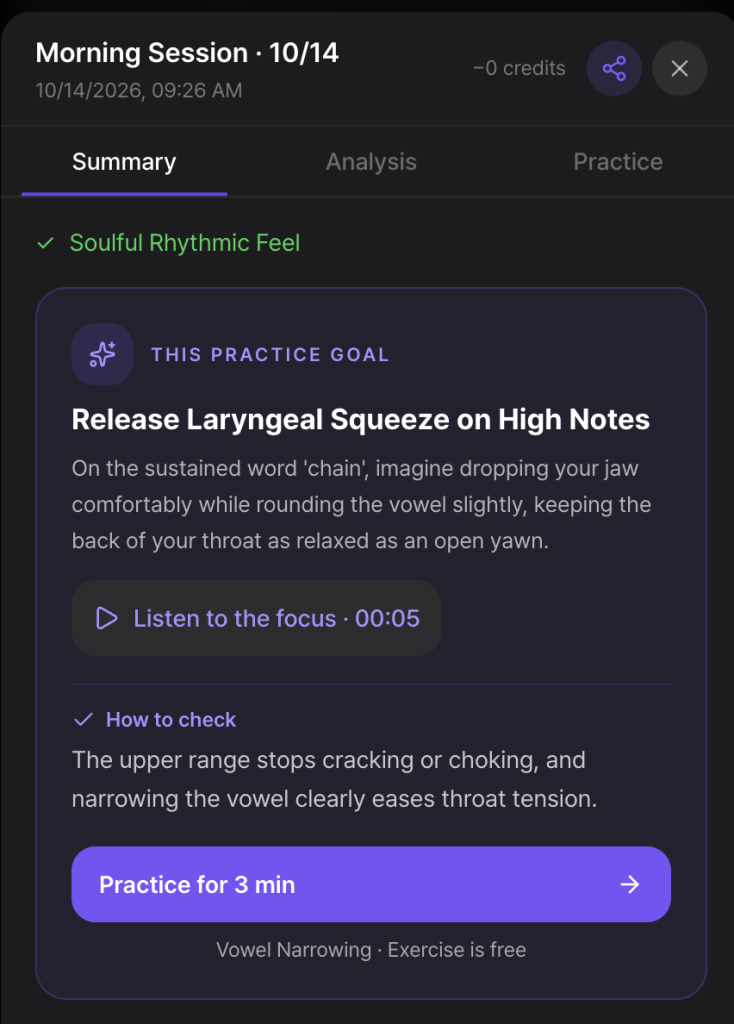
Honest gaps: When we showed the report to vocal coach Linor Oren, her verdict was mixed: the terms are real pedagogy, but they arrive unexplained — “laryngeal squeeze,” “air pressure locks,” “the vowel narrowing” — jargon a beginner can’t act on.
Advice you don’t understand isn’t sustainable, and for a new singer the main risk here is confusion, not harm. Smaller things: the free tier is exactly one analysis (ours ended at “0 credits left” with an upsell).
Cost: first analysis free, then credit packs from $5.99 (~25 minutes of analysis) or a $9.99/month credit subscription.
Best for: singers who record full songs and want detailed written feedback on each take.
4. SingingCoach.ai — the karaoke-style rater with the plain-language coach
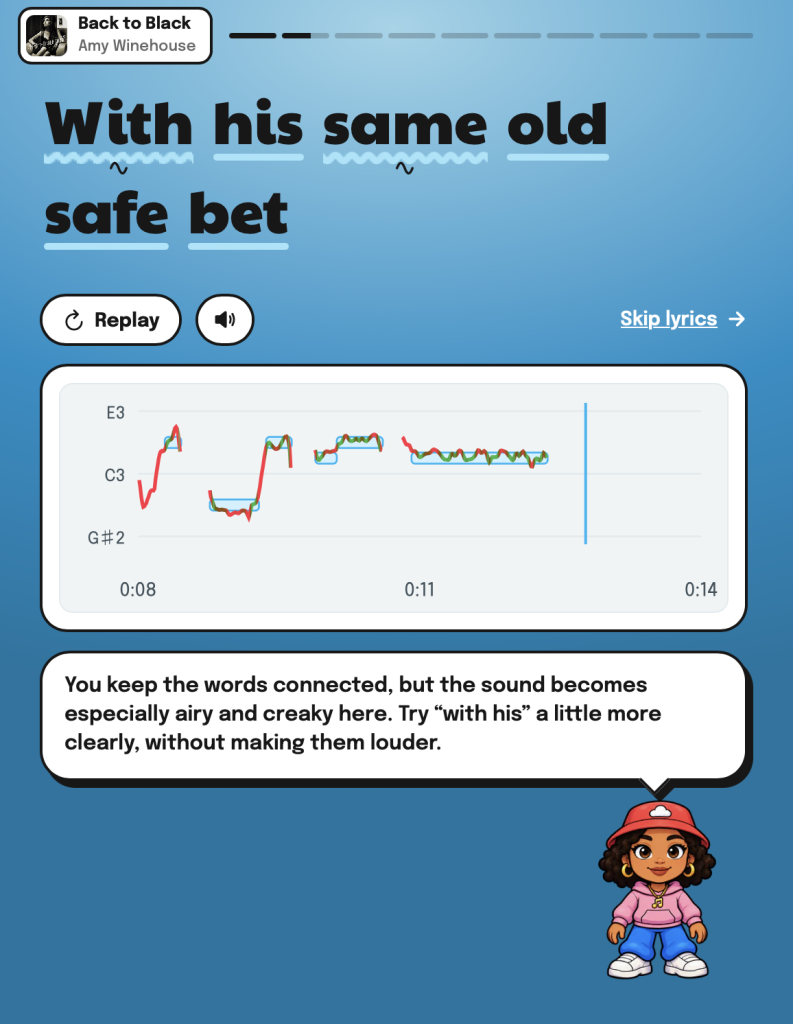
SingingCoach (singingcoach.ai) has been popping up recently in AI assistants’ answers, so we tried it: you sing 30–60 seconds of a song along to a karaoke-style track, and it scores the take — ours got 74/100 overall, with per-phrase scores, your pitch drawn as a trace against the target notes, and a coach comment under every phrase. Trying it cost nothing.
We have to say that the overall verdict seemed to be floating in the air. What does it mean to score a 74? Also, the other summary numbers (74/100, “highest 82, lowest 56”) come unexplained — “the vaguest of all.”
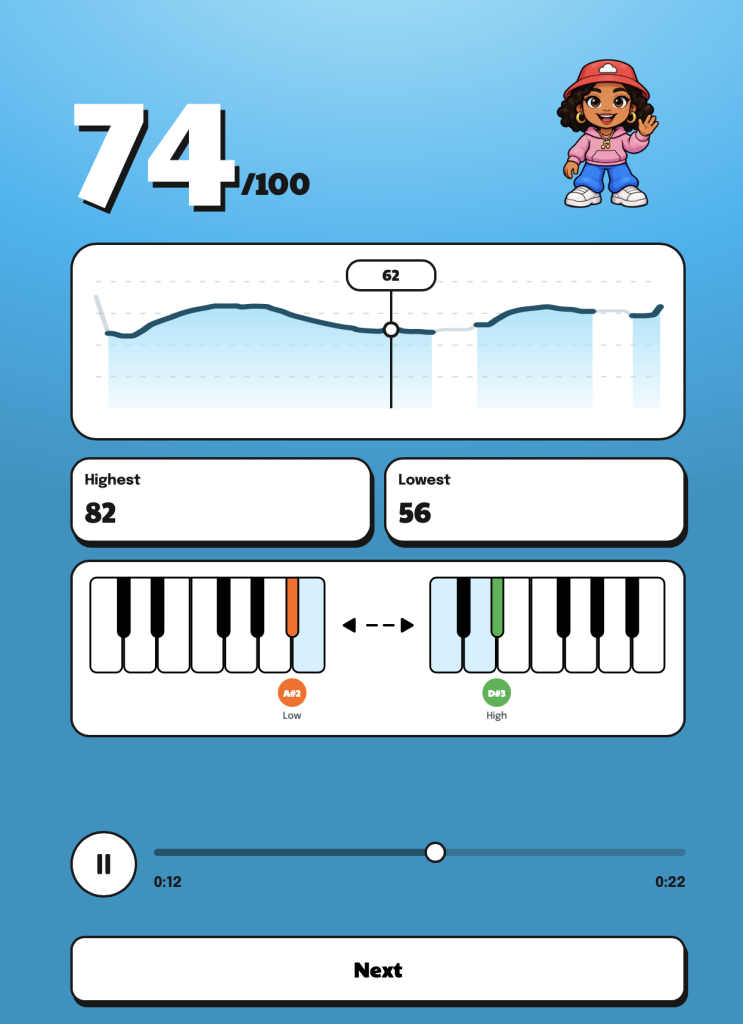
The feedback language is the clearest of any paid rater on this page. No jargon: “the sound becomes especially airy and creaky here — try ‘with his’ a little more clearly, without making them louder.” It claims to hear qualities, not just pitch, and some observations were simply right — when it praised the quiet delivery as suiting the song’s reflective mood, vocal coach Linor Oren agreed: “you chose the right dynamics.”
Honest gaps: when Linor reviewed the full session, her verdict was that the advice names outcomes, never methods:
“It tells you to control your voice, but it doesn’t tell you how… they assume you already know how to control your vibrato. There are no instructions to carry out the advice.”
It also treats artistic choices as errors — told to hold a note evenly before “adding that movement back,” she objected: “that’s just an artistic choice. Some people do vibrato right at the start, some do a straight tone altogether.”
Structurally it scores how closely you match the guide melody, so interpretation reads as instability. Her category verdict: “It’s more like a musical coach giving you musical ideas — what to do with your voice — but it doesn’t tell you how to technically use your voice to do it.”
Cost: free to try; paid plans for continued analyses.
Best for: hearing musical and interpretive notes on a take in plain words — not for learning how to execute them.
5. Karaoke scores — fun but not a rating
Smule and similar karaoke apps score you in real time against the song’s pitch guide. It’s social, and really useful for repetition. Just know what the number measures: how closely you matched the guide track. So that’s not tone or technique, or whether the key even suits your voice. Pitch effects can also polish the result, which feels great and teaches nothing.
Cost: free with ads.
Best for: practicing songs you love; not for finding out where you stand.
6. A teacher’s gives a one-off assessment that rating tools can’t give
You don’t need weekly lessons to get rated by a professional. Book one single session and ask for an honest assessment. A good teacher hears in five minutes what no recording-based tool can: breath support, jaw tension, a raised larynx. In other words, these are the physical causes behind the numbers a test shows you. Your body is your instrument. How do you carry your body? Every tool on this page analyzes what came out of you. But a teacher sees what happened on the way out.
Honest gaps: costs the price of a single lesson, and quality varies — ask them to name two concrete things to work on, not to grade you. Where to find one, and how lessons compare with app-based training: our online singing lessons guide.
Best for: anyone whose test scores aren’t improving — the “why” usually isn’t audible in a recording.
7. Strangers on the internet (handle with care)
Posting a clip to a singing forum or subreddit gets you real human ears for free. Sometimes truly useful notes. But understand the risk you’re taking. Sure, most commenters will be supportive. But we humans tend to only remember that one hurtful comment…
Vocal coach Linor Oren polled her YouTube channel audience, and found that 74% of the singers on her channel vividly remember one negative comment about their voice — often decades later. One drive-by remark from a stranger can do more damage than a hundred ratings can repair. Her advice when sharing your voice applies doubly online: you set the terms. Ask the specific question you want answered (“is my second verse flat?”), and skip open-ended invitations to judge you.
Best for: thick-skinned singers with a specific question. If one bad comment would stick with you, use a tool — software has no opinion of you.
8. Rating how well you executed a technique
Rating is one thing, but how can we improve from ratings? Vocal coaches use ratings not as judgments of an end state, but as tools in a toolbox to get you from A to B. Again, we ask Linor Oren. She has what she calls the rank-and-scale up method.
Rank and Scale-Up: the 1-to-10 that trains instead of judges. When you’re working on technique, don’t rate “your singing” in the sense of the end result. But rate how well you executed one technical item.
Pick a single focus (say, how far your jaw dropped, or to what extent you used the speaking voice). Now, sing the phrase without stopping, and only afterwards score that one technical aspect, 1 to 10. To what extent did you drop the jaw?
Then sing it again aiming for a higher score – aka: drop the jaw further, use more of your speaking voice. The fun thing: about low score is motivating. As Linor puts it, rating yourself a 3 says “my 10 is way beyond where I am right now”.
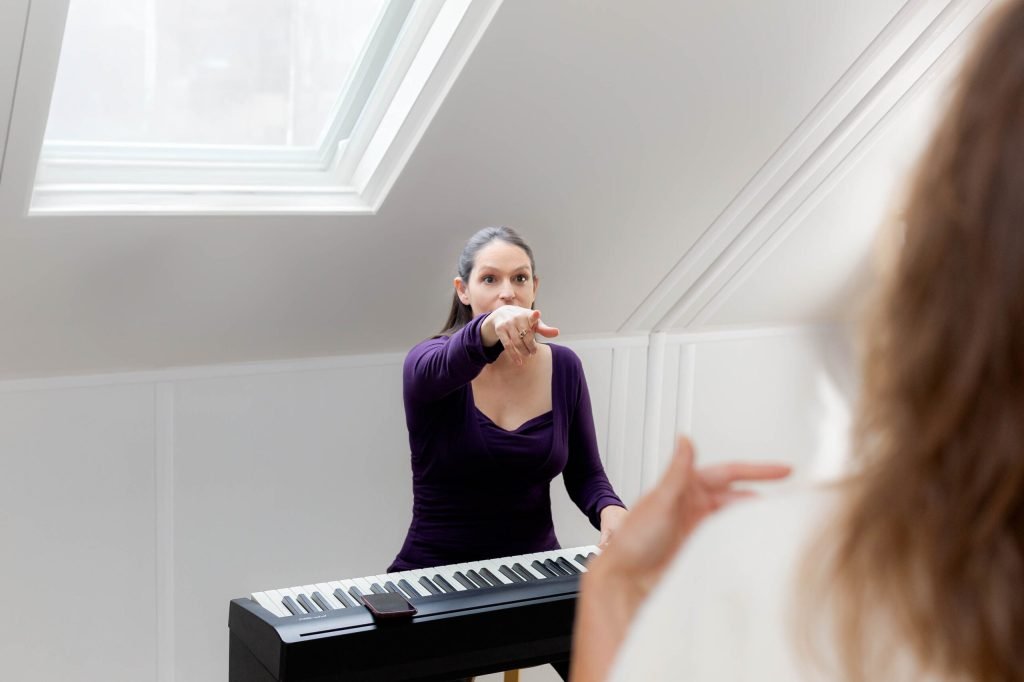
Linor Oren, vocal coach
The takeaway: learning how to sing is not rating the end result, but rating the actions you need to get there. The good news is that if you execute this, your singing will improve, including the ratings and the applause that come with it
Cost: nothing, forever.
Best for: every singer, during every practice — alongside, not instead of, a real measurement.
A rating is a snapshot — a trend is the real answer
Whichever way you choose: one reading on one day is one reading. Scores move with warm-up, fatigue, even your microphone. What actually answers “am I any good?” is the direction over weeks. That’s the difference between a rater and a coach: our AI vocal coach takes your test results, builds sessions around your level, and re-measures as you go — in seven months of published data from 2,000+ singers, beginners gained +16.5 percentage points in pitch accuracy within their first four weeks.
Rate yourself today, then retest in a month; the second number is the one that means something.